Let’s do a little experiment.
I’m going to look around the room I’m in right now and randomly type out a few of the things that I see. Just bear with me:
thumb tack gum paper headphones bananas apples cell phone watch desk computer monitor coffee mug wire remote micro fiber cloth window sky clouds sun glass backpack chair
Seems pretty random, right? But what if I told you that this exact phrase already exists online and, in fact, has already existed online for over a decade? You can find it here. In fact, this very paragraph that I’m typing right now on this day, April thirteenth of the year two thousand and twenty-six already exists, too, and you can find that one here.
So, just what the hell is going on?
Introducing: The Library of Babel
The Library of Babel is a project created by Jonathan Basile. It contains every single possible 3,200-character combination of a 29-character alphabet: the letters A through Z (lowercase only), the comma, space, and period (that’s why I typed the date above using letters instead of numerals, because numerals won’t show up in the library).
The library consists of sections called hexagons, each of which contain four digital bookshelves (yes, four, even despite the name “hexagon”). Each bookshelf contains five shelves with 32 books that each contain 410 pages. Every page of every book has 40 lines, and every line has 80 characters (for our 3,200 total).
That’s a lot to wrap your head around, but the main takeaway is this: every possible combination of 3,200 characters is equivalent to 104679. To put that into perspective, there’s an estimated 1080 atoms in the universe. So it’s a pretty big library.
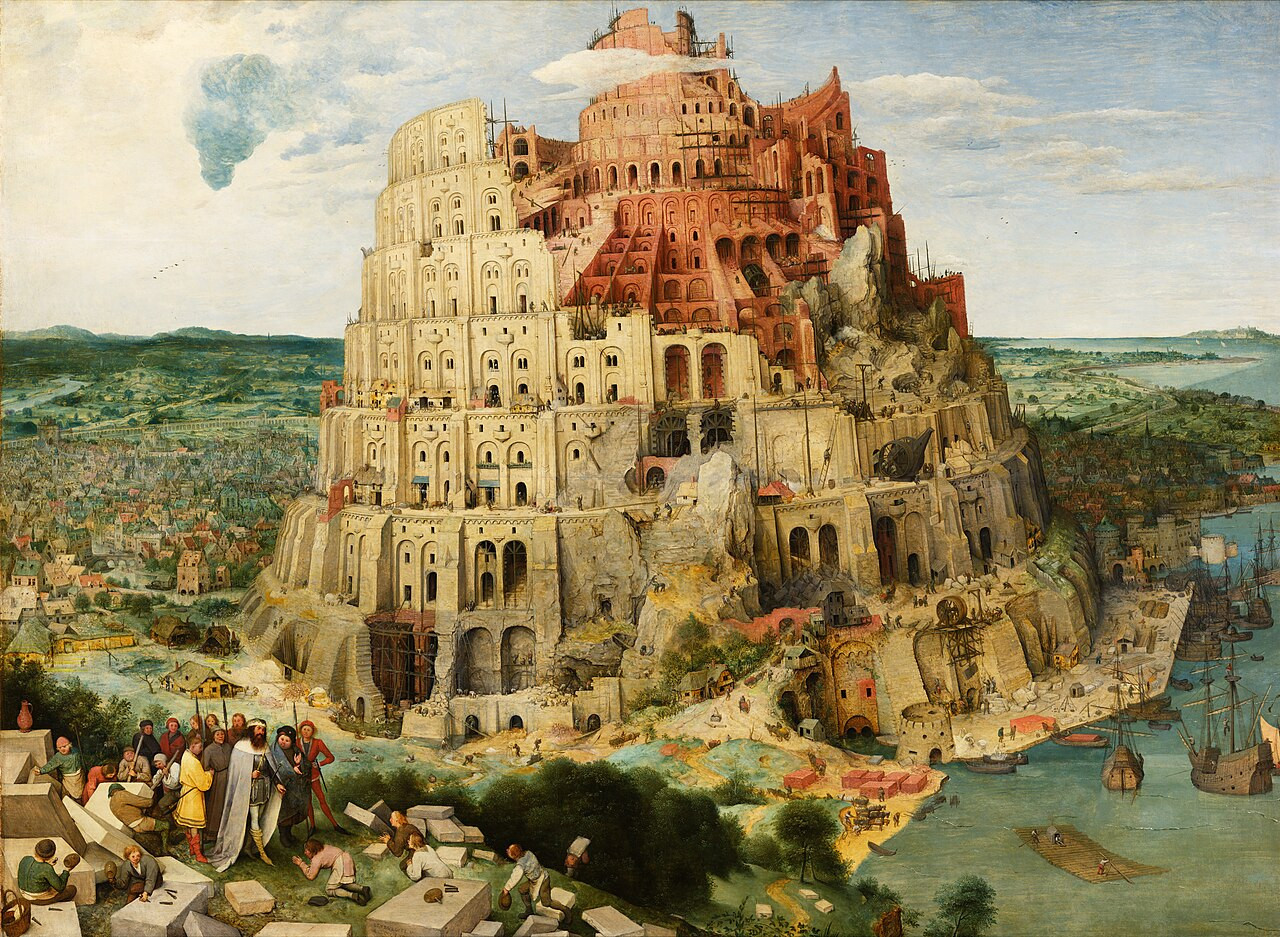
This thing blurs the line between mathematics and language—between possibility and reality. While the entire site is powered by an algorithm created by Basile, it’s still accurate to say that every possible combination of characters has existed since 2015 when he launched the site; they need only be looked up.
Think about it like pi (π). While, say, the trillionth digit of pi may not be stored or written down anywhere, it technically already exists by the nature of the concept of pi. You just need to access it. Similarly, while all of the books, pages, lines, and combinations in the Library of Babel aren’t stored on some server somewhere, the library itself defines a space where they exist. In other words, the library defines a complete, deterministic mapping that uniquely specifies every possible string of 3,200-character text. In that sense, all the texts have “existed” since the system was created.
I’ve heard of a thought experiment that says there may exist some possible combination of words that, if spoken to a person that has been blind since birth, can cause them suddenly to perceive a color. If you could, say, perfectly describe the concept of “blue” to a person who has never seen the color blue in their lives and you described it in the exact right way, that person, through hearing alone, could suddenly visualize the color blue. In theory, that very combination of words does exist somewhere in the Library of Babel. It only needs to be found.
The Library of Babel really does contain everything.
Phonetic Fatalism
One of my favorite bits of Shakespeare is the “to be, or not to be” soliloquy in Hamlet, an incredible musing on death, the afterlife, and existentialism. And there it is, in the library. Though it’s missing the em dashes, apostrophes, colons, and semicolons Shakespeare used to bring the speech to life, we’ll forgive the library its limitations.
In 1969, speechwriter William Safire wrote an incredible speech for Richard Nixon entitled, “IN EVENT OF MOON DISASTER,” to be given in case Neil Armstrong and Buzz Aldrin became stranded on the moon during the Apollo 11 mission. And there it is in the library.
On February 1st, 1992, my grandfather, Louis Cassani, passed away. The St. Louis Review, the newspaper for which he worked, ran his obituary on February 5th, and, you guessed it: There it is in the library.
Perhaps the most interesting aspect of the library is that it doesn’t just cover the past—it covers the future, too. Across enough pages and volumes, it contains everything anyone could ever say. Every possible obituary for everyone, including you and I. It contains wedding vows and divorce proceedings; it contains I-love-yous and I-hate-yous; it contains every word your child will ever say in the exact order in which he or she will say them.
It contains every screenplay, every book, every poem, every article that has—and will ever—be written. It contains everything I’ll ever write professionally and every word I’ll write for this website. As a writer, part of me finds this troubling. This is phonetic fatalism. This is an existential crisis. This muddles what is real and what is fiction. It’s a philosophical conundrum. It’s the entire universe in a few lines of code.
Speak Anyway. Write Anyway.
Thinking about the Library of Babel makes me think about the religious concept of predestination, the Calvinistic idea that God has already determined the destiny of every individual before they were even born. I can’t imagine subscribing to such a concept. Surely its adherence must have wondered at some point or another, “If it’s already been decided that I’m going to heaven or hell, what’s the point? Shouldn't I just do whatever I want here on Earth, then?”
It must have been quite a struggle. Yet, I’m sure those people eventually just got on with life. They dealt with taxes, they dealt with their children, they dealt with the petty squabbles of the mundane. In the face of what I believe to be a cruel, harsh doctrine, they got out of bed each morning, went to work, earned their money, put food on their table, and enjoyed life where and when they could.
I suppose I deal with the Library of Babel the same way. It’s not a perfect analogy, sure—there’s a big difference between some guy's response to a clever algorithm and one’s struggle with the preordination of their post-death fate. But the thought process is the same.
Even if everything that will ever be written or said is out there, language itself isn’t predetermined. We choose what to say and when. We take the phonetic tools available to us and rearrange them in the ways which define our lives.
Even if it can describe it, the Library of Babel can't take anything away from the feeling I get when I see the smile and adoring eyes of my wife after I tell her that I love her. It doesn’t stop feelings from stirring in me when I hear a best man or maid of honor speak at a wedding, even if their speech existed somewhere in the library well before they wrote it. It doesn’t detract from the profound impact I feel when a very wise person imparts a new bit of wisdom to me, even if that bit of wisdom has been locked in the library for years. It doesn’t diminish the sense of accomplishment I feel when I publish a webpage, even if the words on the page already existed in order elsewhere.
Because, like the world and the universe itself, all the matter—all the substance—is already there. All the words exist. All the choices are right there in front of us. But it’s what we do with them and how we react to them that make us uniquely human. Even for a secular humanist like me, it’s what we do with these words that give meaning to the brevity and infinitesimal nature of our lives. Calvinism—predestination—is bullshit. It's you who decides.
So, if someone’s on your mind, reach out. If you have something to say, say it. If you’re afraid or hesitant, don’t be, because the goddamn Library of Babel already contains everything that will ever happen. But it’s you that gets to experience the happening. And we only get to experience so much. So go experience it. Because you have to. Because we have to. Because what else is there?
The library may have the answer, but it's not going to tell us the information on its own. We have to find it.
And with or without the Library of Babel, we will find it. Because we always have.
It's who we are.